

product header background

Products

RILM Abstracts of Music Literature

05 August 2020

The unrivaled global bibliography of writings on music, serving the global music research community

1,777,674
Bibliographic Records
1800s-2025
PubLications Covered
554,970
ARTICLES included with fulL text

What is RILM Abstracts of Music Literature?

RILM Abstracts of Music Literature is a comprehensive bibliography of writings about music, featuring bibliographic citations, abstracts, and indexing. It covers publications in all document types from around the world on traditional music, popular music, jazz, classical music, and related subjects.

Available with Full Text

RILM Abstracts of Music Literature with Full Text expands and enhances the unrivaled global bibliography of writings on music with content from nearly 300 key periodicals published from the early 20th century to the present, most of which are available as full runs, from first to most recent issues. It offers articles and reviews as well as obituaries, editorials, correspondence, advertisements, and news in full text, which can be searched and browsed for each issue, cover to cover. More than 100 journal titles are not available anywhere else online. New journals are being added to the full-text collection every year.

Topics

RILM Abstracts offers an interdisciplinary context for music studies, and therefore actively tracks publications in a wide range of disciplines that includes anthropology, archaeology, architecture, art history, dance studies, dramatic arts, librarianship, literature, pedagogy, philosophy, physics, psychology, sociology, and therapy.

Languages and Countries

RILM Abstracts covers all types of publications on music (both print and digital) from 184 countries and in more than 140 languages. Records include complete bibliographic information with titles in both the original language and English translation, and abstracts in English and, when available, the language of publication. Publications issued in languages using non-Roman alphabets (such as Cyrillic, Chinese, Japanese, Arabic, Korean, Georgian, and Hebrew) are represented bilingually. The full-text content stems from 50 countries. Publications represented in RILM Abstracts are compiled through a collaborative effort between the International Center, RILM’s national committees, and authors who are welcome to submit bibliographic information and abstracts of their publications.
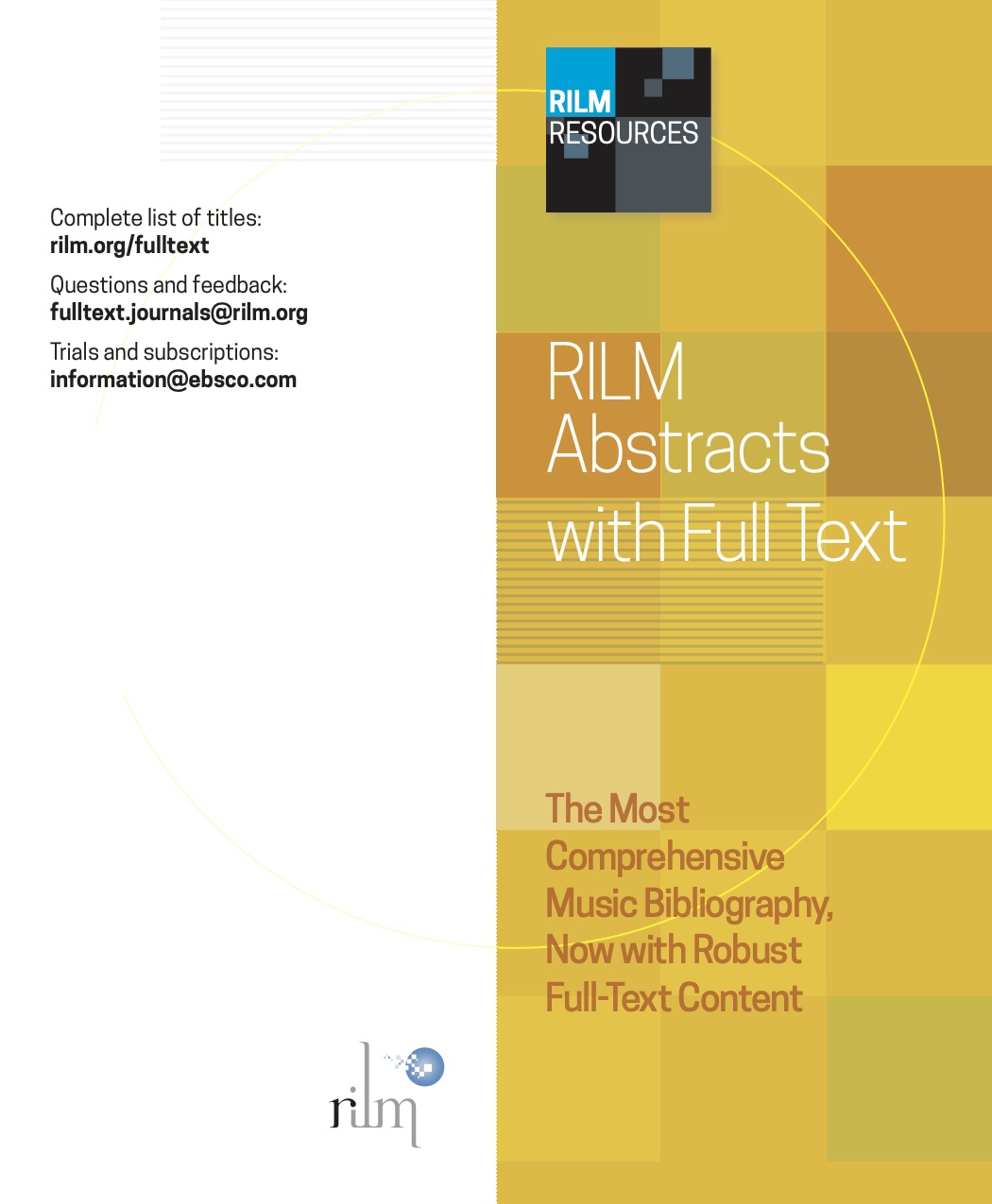
Brochure preview
For more information download the brochure.
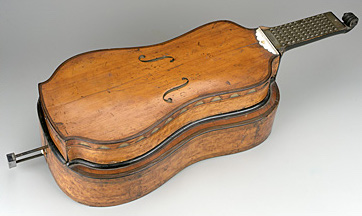
Mélophone, about 1845, Paris, France. Museum of Fine Arts, Boston. Credits

Trials and Subscriptions

For free trials, pricing, and subscription terms, contact EBSCO at https://www.ebsco.com/contact

Discovery

Find RILM Abstracts on EBSCO Discovery Service

Full-Text Journals

A complete list of all full-text journal titles contained in RILM Abstracts of Music Literature with Full Text can be searched and browsed.

Scope

RILM Abstracts covers all types of publications, published anywhere in the world and in any language. These guidelines describe the types of source documents appropriate for inclusion in RILM Abstracts.

The wide range of music-related topics covered in RILM Abstracts is reflected in the list of some 2,400 music journals represented in the database in addition to about several thousand journals from other disciplines and fields.

An overview of selected document types and HTML lists of journals and, soon, full-text journals are available for download.

Searching

The document types covered by RILM Abstracts include all print and digital media. Documents are also grouped under a wide range of document types.

Browse the comprehensive Classification System which groups 99 classes under 16 super classes.

Submissions

RILM welcomes submissions by everybody interested in contributing to RILM Abstracts.

International Center

The RILM International Center in New York City is the organizational hub for the largest music bibliography in the world. Among its principal assets is a staff of experts representing a range of disciplines, languages, and geographic regions. The staff of over 40 includes music specialists from Austria, Brazil, China, Colombia, Croatia, England, Germany, Korea, the Netherlands, Pakistan, Singapore, Slovakia, Ukraine, and the United States, 16 of whom hold doctorate degrees. Several staff members are multilingual, and many are engaged in a spectrum of musical activities.

RILM Index to Scores and Collected Editions

19 August 2020

The digital finding aid for musical works contained in collections, sets, and series

592,520
Works
34,537
Volumes
1,945
series

What is RISE?

Building on the legacy of the Index to Printed Music, RISE is a comprehensive digital finding aid for locating musical works published within collections, sets, and series. It indexes individual pieces found in complete editions of composers’ works, anthologies of music, born-digital editions, and scholarly collections. Each record includes detailed descriptions: performing forces/instrumentation, language, genre, type of score, sources, and publication information. With more than 590,000 entries, RISE expands every year to include new entries as they appear on the market. It is an essential tool for performers and researchers.

New Scope and Enhanced Features

RISE expands on the historical mission of the Index to Printed Music by including digital editions as well as scores outside the Western classical canon. It also contains over 10,000 records with direct links to open-access editions, many of which are born-digital editions. In line with RILM’s global mission, RISE indexes publications from 58 countries across six continents and vocal music in over 100 languages, from Latin to Xhosa.

In addition to its core search features, RISE offers many ways to search the index: the preferred title link connects users to all editions of a work, a full-text limiter shows records with links to open-access editions, and the instrumentation search displays pieces written for a variety of instrumental combinations. Links between different record types facilitate easy navigation from the most granular details of individual works to information on an entire series or collection. 

Brochure preview
For more information download the brochure.
Keyed fiddle (nyckelharpa) and bow, 19th century, Sweden. Museum of Fine Arts, Boston. Credits

Trials and Subscriptions

For free trials, pricing, and subscription terms, contact EBSCO at https://www.ebsco.com/contact

Discovery

Find RISE on EBSCO Discovery Service

Series Covered

History

RISE (formerly the Index to Printed Music) began in 1985 with an NEH grant written by George R. Hill to create a finding aid for musical scores in scholarly editions. Over time, it evolved into a comprehensive database, incorporating the full contents of Collected Editions, Historical Series & Sets & Monuments of Music: A Bibliography by George R. Hill and Norris L. Stephens (Berkeley: Fallen Leaf Press, 1997), itself rooted in Anna H. Heyer’s seminal Historical Sets, Collected Editions, and Monuments of Music: A Guide to Their Contents (American Library Association, 1957–1980). The database was further developed under the James Adrian Music Company, founded by Hill in 2000. Hill continued its growth until 2018, when RILM assumed ownership and editorial stewardship, ensuring its continued expansion and accessibility.

RILM Archive of Popular Music Magazines

30 September 2023

The ever-expanding full-text compilation of zines that facilitates unprecedented federated searches

125+
Zines
1960s-2025
Publication Dates
8+
Countries

What is the RILM Archive of Popular Music Magazines?

The RILM Archive of Popular Music Magazines is an extensive digital collection comprising over 125 independently published popular music magazines and fanzines in circulation from the late 1960s to the present day. These publications have been meticulously scanned from their original print versions. Reflecting the significance of the do-it-yourself (DIY) ethos central to punk counterculture, a substantial portion of the content highlights the diverse punk and related genres that have emerged globally over the decades. With an international perspective, this collection provides valuable insights into various popular music scenes worldwide. Each year, new titles will be added to the collection.

Languages and Countries

In line with RILM’s global mission the content of RAPMM spans multiple languages and countries—currently from Australia, Canada, China, Colombia, Germany, Spain, the United Kingdom, and the United States.

Topics

The zines in RAPMM cover a wide array of popular music genres, highlighting the expansive punk world and its many subgenres, as well as other rock genres, indie, hip hop, and country. The collection explores the history of musical movements and their relation to politics, society, culture, underground scenes, stylistic shifts, and feminism. RAPMM titles include interviews with recognized and unknown artists, band profiles, album and live show reviews, and histories of record labels.

Brochure preview
For more information, download the brochure.
PREVIEW: Explore the RILM Archive of Popular Music Magazines

Trials and Subscriptions

Please contact subscriptions@rilm.org for trials and pricing

Discovery

Information coming soon

Zine Titles

An Excel sheet with all titles contained in RAPMM can be downloaded here.

RILM Music Encyclopedias

05 August 2020

The ever-expanding full-text compilation of reference works that facilitates unprecedented federated searches

75
encyclopedias
1775-2025
Publication Dates
355,000+
Entries

What is RILM Music Encyclopedias?

RILM Music Encyclopedias is an ever-expanding full-text collection of reference works that provides comprehensive encyclopedic coverage of the most important fields and subject areas of historical musicology, ethnomusicology, and theory. An extensive resource, it is designed to meet the teaching, learning, and research needs of the international music communities.

Languages and Countries

In line with RILM’s global mission, the content of RILM Music Encyclopedias spans multiple countries and languages—currently English, German, French, Spanish, Italian, Albanian, Croatian, Czech, Dutch, Greek, Portuguese, and Slovak.

Topics

Topics covered by the reference works in RILM Music Encyclopedias are wide ranging from popular music and rock, opera, instruments, blues and gospel, to performers and women composers.

Brochure preview
For more information download the brochure.
PREVIEW: Explore RILM Music Encyclopedias

Trials and Subscriptions

For free trials and subscriptions on Egret, contact subscriptions@rilm.org

For free trials, pricing, and subscription terms, contact EBSCO at https://www.ebsco.com/contact

Discovery

Find RILM Music Encyclopedias on EBSCO Discovery Service

Encyclopedia Titles

An Excel sheet with all titles contained in RILM Music Encyclopedias can be downloaded here.

DEUMM Online

15 June 2022

The most important modern music dictionary in the Italian language

1983-present
Years of Publication
13,000+
Subject Entries
22,000+
Biographical ENtries

What is DEUMM Online?

DEUMM Online digitizes, enhances, and extends the Dizionario enciclopedico universale della musica e dei musicisti (DEUMM), the most extensive modern music dictionary in the Italian language. DEUMM was first issued in print between 1983 and 2005 by the renowned Italian publisher of reference works, UTET Grandi Opere, under the editorship of Alberto Basso. Comprising a broad range of entries (persons, topics, dances, genres, geographical locations, institutions, instruments, and works), DEUMM Online is available on RILM’s Egret platform, gaining advanced and intuitive search and translation functionalities. The content in DEUMM Online is linked to other RILM resources as well as external databases such as the Virtual International Authority File (VIAF) or the OPAC SBN. This venerable music encyclopedia, which has set the standards in modern Italian music lexicography, is, in its new online format, an indispensable node in a comprehensive, international, networked research experience that only RILM can provide.

Original Content

Number of entries published in the print edition:

  • 247 organ registers
  • 541 genres
  • 488 dances
  • 1630 instruments
  • 441 countries & cities
  • 2147 topics
  • 7381 works
  • 21,856 biographies
  • 2554 families
Alberto Basso’s list of entries planned for the original edition

Updated Content

DEUMM Online publishes 150 new or updated articles per year. The newly created content reflects both the current trends in Italian and global music scholarship, expanding particularly in the areas of popular music, film music, jazz, traditional music, world music, and music in antiquity. Priority is given to biographical entries for composers and musicians active since the 1980s; geographical entries for countries and cities, and Italian towns in particular; entries for ethnic groups and cultures; institutions; and performance practice. Given the significance of Italian music throughout the centuries and the presence of Italian musicians throughout the world, DEUMM Online will remain the ultimate resource for the study of all aspects of Italian musical culture.

The Team

The core editorial team consists of Prof. Dr. Daniela Castaldo of the Università del Salento and Prof. Dr. Antonio Baldassarre of the Lucerne University of Applied Sciences and Arts and, who serve as General Editors; Dr. Diana Blichmann who is the Managing Editor; and Dr. Zdravko Blažeković, who is directing the project behalf of RILM. The team is advised by a team of by Subject Editors with an expertise in a variety of music-related topics.

PREVIEW: Explore DEUMM Online


Trials and Subscriptions

For subscriptions, free trials and quotes, contact subscriptions@rilm.org

Discovery

Find DEUMM Online on EBSCO Discovery Service

History

Brochure preview
For more information, download the Italian booklet.
Brochure preview
For more information, download the brochure.

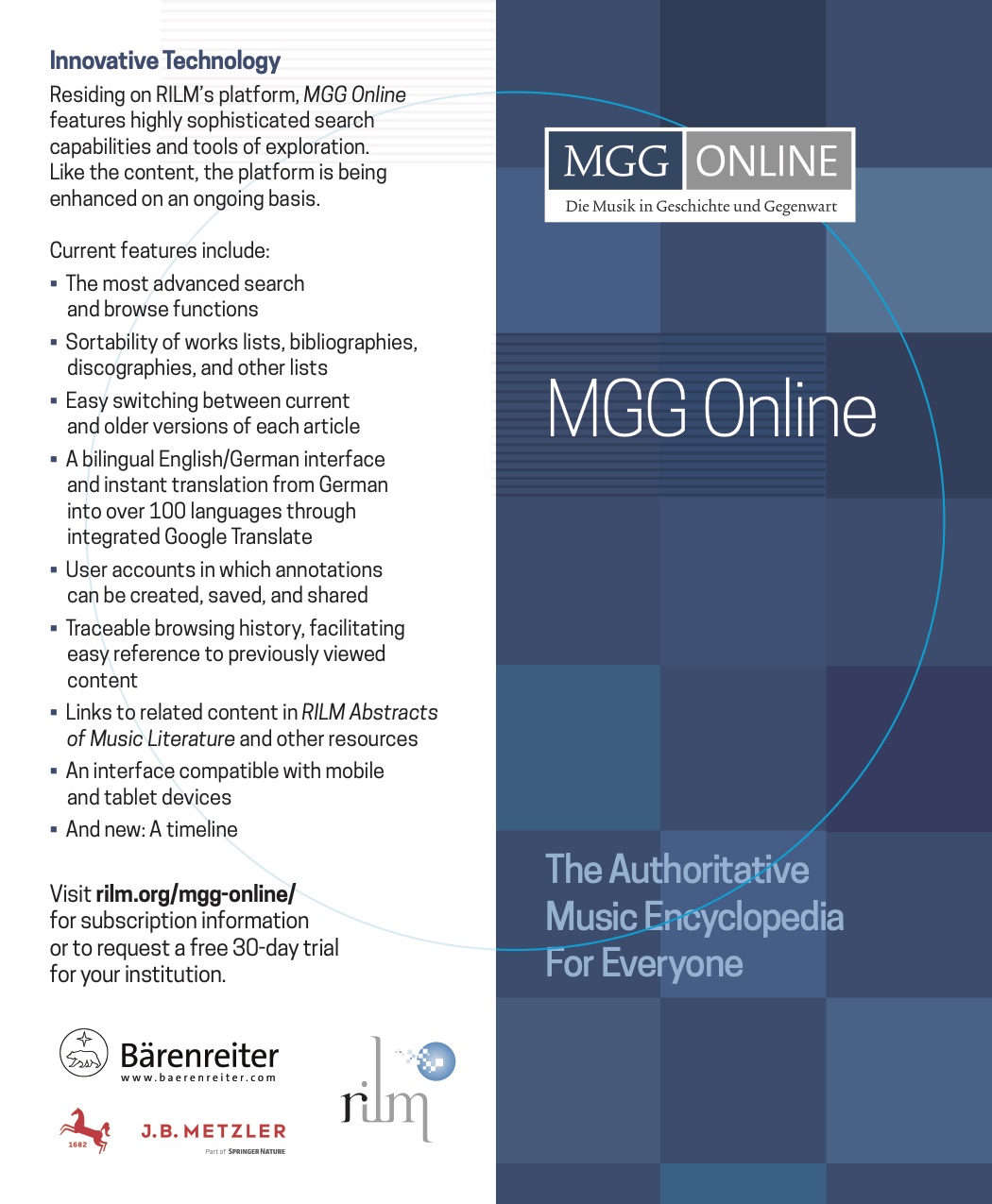
MGG Online

11 October 2020

The preeminent digital encyclopedia for music researchers worldwide

1994-2025
Years of Publication
4,000+
Subject-Related Entries
16,000+
Biographical ENtries

What is MGG Online?

MGG Online builds on the second edition of Die Musik in Geschichte und Gegenwart (MGG, 1994–2008), offering new and substantially updated content as well as continuous updates, revisions, and additions. MGG Online is being developed by Bärenreiter and J. B. Metzler in partnership with RILM.

Topics

MGG Online‘s content covers a wide array of topics not only in all areas of music, but also in related fields, such as literature, philosophy, and the visual arts. An openly accessible article reflecting the content and all functionalities of MGG Online can be sampled by navigating to the regularly updated Free Article featured on the MGG Online homepage. 

mgg online website homepage shows search box, menus and sections
PREVIEW: Explore MGG Online

Trials and Subscriptions

For free trials and subscriptions on Egret, contact subscriptions@rilm.org

Discovery

Find MGG Online on ExLibris Discovery

Find MGG Online on WorldCat Discovery

Find MGG Online on EBSCO Discovery Service

History

The title is its mission: to represent Die Musik in Geschichte und Gegenwart in an encyclopedic undertaking—an exhaustive scholarly project straddling ages and continents, carried by internationally renowned experts. More than 3,500 authors had written more than 19,000 articles covering almost every aspect of music and its history for the roughly 25,000 pages of the second print edition of MGG

Scope

30 October 2020

RILM Abstracts of Music Literature covers all types of publications on music, published anywhere in the world and in any language. The document types covered include all print and digital media.

Publications represented in RILM Abstracts are compiled through a collaborative effort between the International Center RILM’s national committees, and authors who are welcome to submit for indexing the bibliographic information and abstracts concerning their own publications. The over one and a half million records include titles in the original language and English translation, bibliographic information, and abstracts in English and, when available, the language of publication. Records for publications issued in languages using non-roman writing systems (such as Cyrillic, Chinese, Japanese, Arabic, Korean, and Hebrew) are represented bilingually.

Over the past two decades RILM has dedicated significant additional resources to the coverage of ethnomusicology, popular music, and jazz studies. RILM is also committed to establishing an interdisciplinary context for music studies, and therefore actively tracks publications in a wide range of disciplines that includes anthropology, archaeology, architecture, art history, dance studies, dramatic arts, librarianship, literature, pedagogy, philosophy, physics, psychology, sociology, and therapy. The wide range of music-related topics covered in RILM is reflected in the list of some 2,400 music journals represented in the database in addition to several thousand journals that focus on other disciplines and fields.

The official scope guidelines of RILM Abstracts are available in English, French, and German.

Paralleling breadth in content, RILM Abstracts of Music Literature also offers a full-text enhancement. Both are updated monthly to maximize currency.

RILM Abstracts of Music Literature with Full Text

RILM Abstracts of Music Literature with Full Text expands upon that unrivaled global bibliography of writings on music with the addition of full-text content from 290 periodicals, from 50 countries, published since the early 20th century. Coverage of most periodicals commences with the first issue of the journal run.

RILM Abstracts of Music Literature

RILM Abstracts of Music Literature indexes literature on music published since the early 19th century. Conference proceedings are indexed back to 1835, and Festschriften to 1840. The coverage of music periodicals from before 1967 is coordinated with RIPM Retrospective Index to Music Periodicals in order to avoid possible duplication. To learn more about the RILM-RIPM collaboration, see our jointly created flyer.

Scope Guidelines

31 October 2020

These guidelines describe the types of source documents appropriate for inclusion in RILM Abstracts—referred to in these guidelines as “RILM material”.

RILM material falls into two broad categories: (1) writings and other resources that provide an analysis, show the results of systematic research, or give a critical opinion or interpretation; (2) writings and other resources that provide important source material (including but not limited to correspondence, interviews, obituaries, conference reports, criticism, and biographies). RILM material can be published in any format.

Many musical fields rely on publications that are traditionally scholarly in nature, while others—especially those related to current musical life—have come to rely on a broader range of publications for much of their source material. Inclusion decisions should take this into account, bearing in mind that publications relied upon by music scholars are appropriate for inclusion in RILM Abstracts.

Document types of RILM material

RILM Abstracts includes all writings and resources likely to be of value to music researchers, whether printed, digital, or in any other format. The first priority is to cover the most important and scholarly items from all subject areas. While RILM material appears in different publication types from one country to the next, in general, priority will be given to core journal articles, monographs, essay collections, conference proceedings, Festschriften, dissertations, and theses.

Periodical coverage

All periodical articles on music and related disciplines are considered to be RILM material. Given the vastness and variation of this literature, the following coverage priorities have been established. The first three categories (core, secondary, and tertiary) pertain specifically to music journals and represent a descending order of priority.

Core journals: These are flagship journals of music studies; all articles are abstracted and all book reviews are cited (film and sound recording reviews are cited at the discretion of RILM editors). Core status is assigned to journals by the national committees, which thereby commit to fully abstracting them and in a timely manner. The RILM International Center may also assign core status to a journal, particularly (but not exclusively) for journals published in countries with no national committee; in such cases, staff editors at the Center abstract the journal. The International Center may also remove the core status of a journal if it is not being covered consistently. All core journal issues should be available to staff editors at the International Center.

Secondary journals: These are also deemed significant for music studies. They are systematically scanned for articles that fall within RILM’s scope guidelines, and these articles are abstracted. Secondary status is assigned primarily by national committees, which thereby commit to scanning each issue, upon publication, for RILM content, and abstracting that content. The International Center may also assign secondary status, or, if a title is not being systematically scanned and abstracted, it may remove secondary status. Wherever possible, secondary journal issues should be available to staff editors at the International Center.

Tertiary journals: These are less oriented toward music scholarship. They are not systematically scanned, and their contents are abstracted selectively.

Other disciplines: Articles on music from multi-disciplinary and other non-music journals are also entered into the database by the national committees, authors, and RILM International Center staff.

The four categories described above are for periodical articles in any media. If the article is part of an electronic journal or website, the following criteria must be met: (1) there is a procedure in place for archiving the journal or site; (2) there is an editorial policy in place; (3) the journal is published regularly; (4) the journal has a publisher (that is, it is not self- or editor-published).

An abstract for an entire issue of a periodical is to be sent to the International Center if it is a special issue devoted to a particular topic and is designated as a “thematic” issue in its title or on its title page or spine.

Publishers are invited to submit their periodicals to RILM International Center in order to have their content included in RILM abstracts.

Collections (Festschriften, conference proceedings, collections of essays)

RILM material includes collections of essays, Festschriften, and conference proceedings. For such collections, a citation (with or without abstract) must be provided for the collection as a whole (a cover record), and each individual article must also receive a citation and an abstract (analytic records). National committees must strive to include a record for every article when the collection is entirely devoted to music, ensuring the inclusion of complete collections in RILM Abstracts. In cases where only some of the articles pertain to music, a cover record for the collection is required, as well as individual citations and (where possible) abstracts for each music-related item only. Collections of articles by a single author should include an abstract for each article separately.

Monographs and other books

Besides original monographs, RILM material includes facsimiles of literature on music (reproductions of early printed editions or manuscripts), reprints, new or revised editions, translations, and catalogues of exhibitions.

Dissertations and theses

RILM material includes doctoral level (or highest postgraduate degree level) dissertations in music and in other disciplines when they concern music. Master’s level or other student theses are included when they contain significant new information or a new interpretation, and are publicly available.

Electronic resources

RILM material includes electronic resources that are of value to researchers, including, but not limited to, websites, blogs, podcasts, databases, CD-ROMs, and other media.

Reviews

RILM includes reviews of any material that falls within its scope. In general, reviews that describe or critically assess a given publication are included; those that merely mention a publication’s existence are not. All reviews listed in core and secondary journals should be included without exception.

Technical drawings of historical instruments

Special caution is to be applied in reviewing the following kinds of materials for inclusion in RILM Abstracts:

  • Editions of music (including facsimiles) should be entered only when they include substantial written material (scholarly apparatus, source studies, notes on performance). 
  • Articles from daily newspapers and magazines only when they offer important information not available elsewhere, such as obituaries, or are major critical articles that include results of original research. 
  • Program notes, pamphlets, brochures, and other small separate publications only if they are of particular importance to music researchers and are publicly available. 
  • Sound and video recordings only when one or more of the following criteria are met: (1) when the recording or film is important source material for ethnomusicological, popular, or performance studies; (2) when the recording is accompanied by substantial written material; or (3) when the recording or film is the subject of a review. 
  • Feature films that claim biographical authority should be included. 
  • Reviews of concerts only when the review itself can be considered RILM material and is therefore of particular importance to music researchers.

RILM Abstracts excludes writings unlikely to be of value to music researchers, including the following:

  • Practical manuals and “how-to” books, unless they are modern editions of important historic texts, have received substantial reviews, or are otherwise of particular value to music researchers.
  • Rudimentary instructional manuals, with the same exceptions as above.
  • Outlines for classroom use. Reviews that are merely publication announcements.

Subject categories of RILM material

RILM Abstracts includes writings and other resources on music and related disciplines, including the following:

  • Historical musicology
  • Ethnomusicology, including reviews of sound and video recordings in RILM core periodicals
  • Popular music and jazz
  • Theory, analysis, and composition
  • Sound sources, instruments, their techniques, reprints of historical teaching methods and treatises, makers, technical drawings of historical instruments.
  • Performance practice and notation
  • Pedagogy
  • Reference and research materials, including catalogues of temporary exhibitions and permanent museum collections, discographies, directories, encyclopedias, bibliographies, composers’ work lists issued by music publishers, and library catalogues. Research material available on websites should be included.
  • Music and other arts, including but not limited to dance, dramatic arts, poetry and literature (including novels about composers written with biographical authority, if reviewed in a music periodical covered in RILM abstracts), items on music iconography, and music and art
  • Music and related disciplines, including but not limited to philosophy, aesthetics, criticism, psychology, hearing, perception, physiology, therapy, medicine, archaeology, anthropology, engineering, sound recording, acoustics, architecture, computers, sociology, linguistics, semiotics, printing, engraving, publishing, economics, copyright, and other legal matters
  • Music in liturgy and ritual

Book Publications

23 October 2020

Browse our publications from the acclaimed style guide and retrospective bibliographies to a collection of scholarly essays in the histories of academic disciplines

RILM’s Style Manual

A comprehensive style guide that addresses special problems faced by writers on music, now in its third edition and available as e-book.

RILM Perspectives

RILM Perspectives is a series of conference proceedings sponsored by RILM, exploring major issues in music studies. The inaugural volume, Music’s Intellectual History, documents the conference inspired by the publication of Speaking of Music: Music Conferences, 1835–1966.

front cover of Music's intellectual history

RILM Retrospectives

Since 1972 RILM has been publishing topical bibliographies. The two most recent volumes in RILM’s Retrospective series are Speaking of Music: Music Conferences 1835–1966 and Liber Amicorum: Festschriften for Music Scholars and Nonmusicians, 1840–1966.

front cover of Speaking of music

Document Types

30 October 2020

Documents are grouped under a wide range of document types.

Document types

AB – Article in a periodical treated as a book
AC – Article in a collection or critical edition
AD – Article in a dictionary
AE – Article in a Festschrift
AG – Article in a blog
AK – Article in a periodical: music work
AL – Article in a newsletter
AM – Article in a magazine
AN – Article in a newspaper
AP – Article in a periodical
AS – Article in a symposium/conference proceedings
AW – Article in an edition of music
EA – Article in an electronic resource

BC – Collection of essays
BD – Encyclopedia or dictionary
BE – Festschrift
BF – Facsimile or reprint edition
BG – BlogBM – Monograph
BP – Periodical (thematic issue)
BS – Symposium proceedings
BT – Translation
BX – Textbook

MP – Motion picture
MR – Sound recording

CP – Program notes
CR – Recording notes
CS – Commentary apart from edition
CW – Edition of music

DD – Doctoral dissertation
DM – Non-doctoral thesis

EP – Podcast
ER – Electronic resource
JZ – Fanzine
MD – Technical drawing of instruments
PM – Printed music contained in a collection

RA – Review of an article
RB – Review of a book
RC – Review of a collection
RD – Review of a dissertation
RE – Review of a Festschrift
RF – Review of a facsimile or reprint
RM – Review of an edition of music
RN – Review of a technical drawing
RP – Review of a periodical
RR – Review of a recording
RS – Review of a symposium proceedings
RT – Review of a translation
RV – Review of a motion picture
RX – Review of an electronic resource